A garage door that stops working disrupts your entire day. Whether you are dealing with a door that won’t open, a loud snap in the night, or a cable hanging loose along the track, knowing what is wrong and what to do next saves time, money, and stress. This guide covers the three most common issues homeowners face: professional garage door repair Queens, a broken garage door spring, and garage door cable replacement.
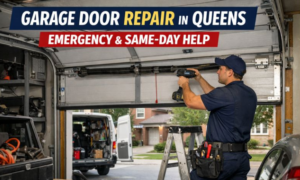
Garage Door Repair: What It Covers and When to Call a Professional
Garage door repair is a broad term that covers everything from a simple sensor adjustment to a full opener replacement. The key is understanding which problems are safe to handle yourself and which require a trained technician.
Common Problems That Require Garage Door Repair
Most service calls fall into a few repeating categories. A door that reverses before closing usually points to a misaligned safety sensor or an opener limit setting that needs adjustment. A door that stops halfway typically signals a broken spring or snapped cable reducing the motor’s lifting capacity. Grinding or scraping sounds during movement often mean worn rollers or loose track hardware that is vibrating under load. Intermittent remote failures are commonly caused by dead batteries, antenna interference, or frequency conflicts with newer smart home devices.
DIY vs. Professional Repair: Know the Boundary
Homeowners can safely handle a handful of minor tasks: lubricating rollers and hinges with a garage door-rated spray, tightening loose bracket bolts, cleaning sensor lenses, and replacing remote batteries. Everything else, including spring work, cable tension, track realignment, and motor repair, should be handled by a licensed technician. Garage doors weigh between 130 and 400 pounds, and the springs and cables that counterbalance that weight store significant mechanical energy. Mishandling them causes serious injury.
What a Professional Diagnostic Inspection Looks Like
A thorough garage door repair Queens starts with a full-system inspection, not just a look at the obvious failure point. The technician runs the door through several cycles, checks spring tension, cable alignment, roller wear, track straightness, and sensor calibration before quoting any repair. This matters because garage door problems rarely occur in isolation. Fixing only the visible symptom without inspecting related components often leads to a second failure within weeks. Annual professional tune-ups are the most cost-effective way to keep the system running reliably and catch issues before they become emergencies.
Broken Garage Door Spring: Causes, Warning Signs & What the Fix Involves
A broken garage door spring is one of the most dramatic failures a homeowner can experience. The loud bang it produces when it snaps is often mistaken for something more alarming. Understanding why it happens, how to spot it early, and what the repair process involves takes the mystery out of one of the most common garage door service calls.
Why Garage Door Springs Break
Every spring has a rated cycle life. A standard residential torsion spring is built for approximately 10,000 cycles, where one cycle equals one open and one close. At two uses per day, that translates to roughly 13 years of service. Heavy-use households can exhaust that cycle count in five to seven years. Beyond normal wear, rust and corrosion thin the metal and increase friction, lack of lubrication grinds away coil surfaces over time, improper spring sizing causes the spring to work harder than it was designed to, and temperature extremes fatigue the steel through repeated expansion and contraction. Cold snaps in particular are notorious for triggering spring failures in systems that are already near the end of their service life.
Warning Signs Before a Spring Breaks Completely
- The door feels unusually heavy when lifted manually during a power outage
- Squeaking or creaking at the top of the door’s travel where spring tension is highest
- The door rises or lowers unevenly, one side lagging behind
- Visible rust, discoloration, or a small gap in the spring coil
- The opener strains audibly or triggers its auto-reverse feature without obstruction
How a Broken Spring Is Replaced
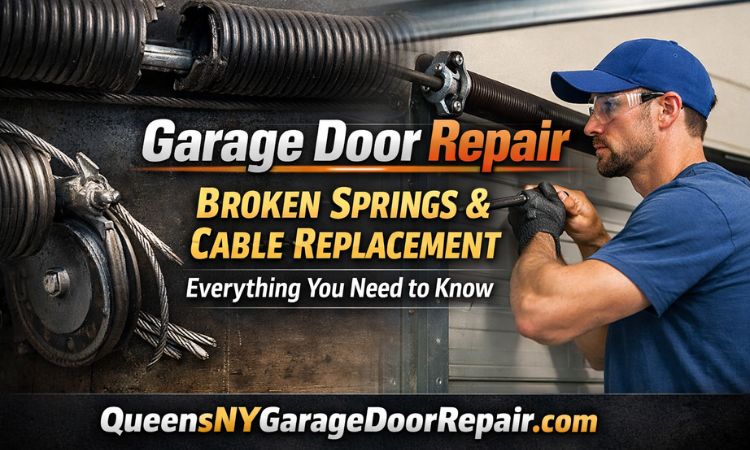
Spring replacement is a job strictly for trained professionals. The technician secures the door, carefully unwinds and removes the broken spring using specialized winding bars, inspects the shaft and cones for damage, then installs new springs sized precisely to the door’s weight and height. The repair ends with a balance test: the opener is disconnected and the door is raised manually to mid-height. A correctly balanced door holds its position without drifting.
On dual-spring systems, both springs should always be replaced together.
When one breaks, the other is at a comparable wear stage and will typically fail within months. Replacing both in a single visit avoids a repeat service call and ensures balanced tension across the door. Upgrading to high-cycle springs rated for 25,000 or 50,000 cycles at this point is a sound long-term investment.
Garage Door Cable Replacement: Why Cables Fail and What the Service Involves
Cables are the quiet backbone of the garage door system. They transfer spring energy into smooth, controlled movement, and when they fail, the door can hang crooked, move unevenly, or drop without warning. Garage door cable replacement is a critical safety service that deserves the same attention as spring repair.
How Cables Work and Why They Fail
Braided steel cables run vertically along each side of the door, attaching at the bottom corner brackets and winding around drums at the top of the system. They carry the full weight of the door during every open and close cycle. Cable failures occur for several reasons. When a spring breaks, the cable on that side loses tension instantly, causing it to go slack, tangle, or kink. Moisture and road salt corrode the individual wire strands over time until the braid weakens and snaps. Worn drum grooves allow the cable to jump its guided path, leading to uneven winding. Misaligned rollers or tracks create friction points that gradually cut through cable strands over hundreds of cycles.
Signs You Need Garage Door Cable Replacement
- Visible fraying: individual strands are separated, bent back, or broken
- The door hangs crooked or one side sits noticeably lower than the other
- The door shudders or jerks during movement rather than traveling smoothly
- A cable has visibly jumped off the drum and lies slack along the track
- A snapping sound followed by the door becoming heavy or unresponsive
A broken or severely frayed cable makes the door structurally unsafe. Do not continue operating the door until a technician has completed the replacement.
What Garage Door Cable Replacement Involves
The technician begins by securing the door in its lowest position and disconnecting the opener. If a broken spring contributed to the cable failure, it is addressed first since spring tension directly affects cable installation. The old cable is removed from the bottom bracket, unwound from the drum, and replaced with a new cable sized to the door’s specific height and weight. Standard residential doors use 1/8-inch diameter cable; heavier doors may require 3/16-inch. The new cable is wound onto the drum with the correct number of turns to establish proper tension, and both sides are set to match. A manual balance test follows before the opener is reconnected and a full cycle test confirms smooth, even travel.
As with springs, both cables should always be replaced together.
When one cable shows significant wear or failure, the other is at a comparable stage. Replacing both at the same appointment avoids a repeat service call and ensures the door travels evenly. Since labor is the primary cost driver in a cable job, doing both at once is almost always the more economical choice.
Schedule a Professional Inspection Before a Small Problem Becomes a Big One
Garage door repair, broken spring service, and cable replacement share a common lesson: the earlier a problem is caught, the less it costs to fix and the safer the door remains. If your door is showing any of the warning signs described in this guide, contact a certified garage door technician and schedule a diagnostic inspection. A proactive service call is almost always far less expensive than an emergency repair, and a properly functioning door protects your home, your vehicle, and everyone who uses it every day.
Immediate steps you can take
Don’t wait for a complete failure. Annual maintenance, listening for unusual sounds, and visual checks of springs and cables can add years to your system. But always remember: when in doubt, call a professional.
Garage door safety is non-negotiable
A door under tension contains enough stored energy to cause life-threatening injuries. Respect the system, and rely on certified technicians for all spring, cable, and major mechanical repairs.
Your local garage door professionals are ready to help
Whether you need a routine tune-up, emergency cable replacement, or spring repair, trained experts in your area provide same-day service and transparent pricing. Protect your investment and your family — schedule your inspection today.

 How to Align Garag..